CURRICULUM

Subinternship Curriculum

The STFM Subinternship Curriculum was designed by an STFM task force consisting of UME and GME educators and learners to create a standardized national family medicine subinternship curriculum. Access the free curriculum and other resources below on this page.

DOWNLOAD THE CURRICULUM

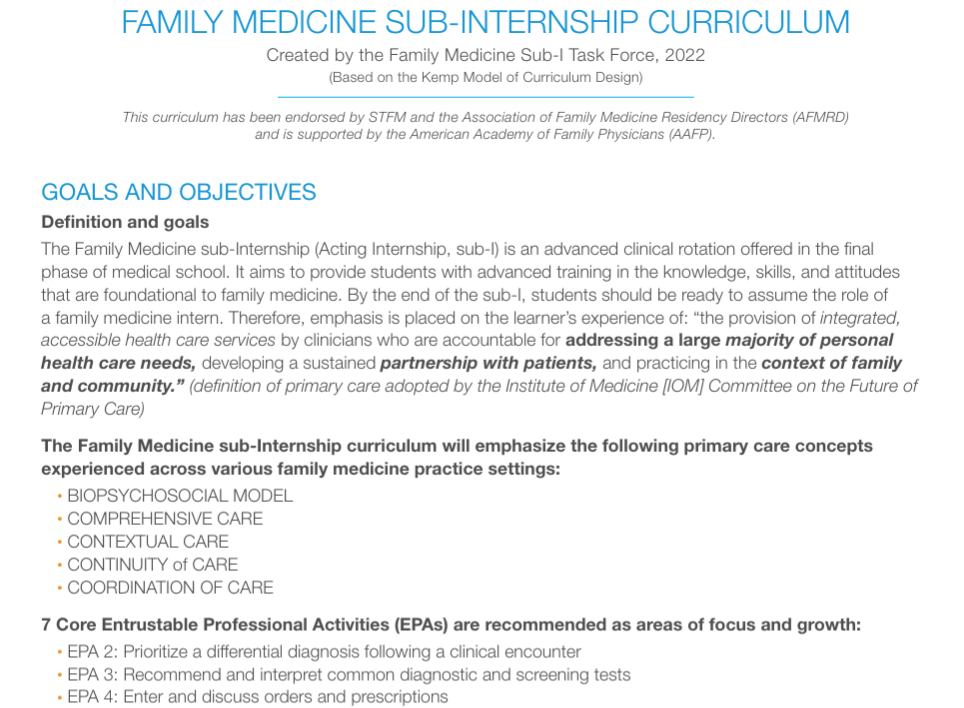
The Family Medicine Subinternship (Acting Internship) is an advanced clinical rotation offered in the final phase of medical school. It aims to provide students with advanced training in the knowledge, skills, and attitudes that are foundational to family medicine. By the end of the subinternship, students should be ready to assume the role of a family medicine intern.The STFM Subinternship Curriculum was designed by an STFM task force consisting of UME and GME educators and learners to create a standardized national subinternship curriculum. Subinternships are a critical educational experience in family medicine and are a way to further expose students to positive family medicine experiences.This curriculum has been endorsed by STFM and the Association of Family Medicine Residency Directors (AFMRD) and is supported by the American Academy of Family Physicians (AAFP).

Key Features of the Curriculum

  • Builds off the foundations of the STFM National Clerkship Curriculum with the input of multiple stakeholders
  • Uses Entrustable Professional Activities (EPAs) as a cornerstone of curricular elements and student assessment
  • Provides a framework while allowing for flexibility and individualization
  • Incorporates self-assessment by learners
  • Recommends institutions provide appropriate support for this rotation through dedicated faculty and administrative support staff time

The Family Medicine Subinternship Curriculum emphasizes the following primary care concepts experienced across various family medicine practice settings:

  • Biospychosocial Model
  • Comprehensive Care
  • Contextual Care
  • Continuity of Care
  • Coordination of Care

Entrustable Professional Activities (EPAs)

7 Core Entrustable Professional Activities (EPAs) are recommended as areas of focus and growth:

  • EPA 2: Prioritize a differential diagnosis following a clinical encounter
  • EPA 3: Recommend and interpret common diagnostic and screening tests
  • EPA 4: Enter and discuss orders and prescriptions
  • EPA 7: Form clinical questions and retrieve evidence to advance patient care
  • EPA 8: Give or receive a patient handover to transition care responsibility
  • EPA 9: Collaborate as a member of an interprofessional team
  • EPA 10: Recognize a patient requiring urgent or emergent care and initiate evaluation and management

STFM Subinternship Curriculum Project Task Force Members

Chair

  • Tomoko Sairenji, MD, MS, University of Washington, Seattle, WA, Past Chair of the STFM MSE Collaborative Steering Committee

Faculty

  • Sarah Stumbar, MD, MPH, Florida International University, Herbert Wertheim College of Medicine, Miami, FL
  • Marisyl de la Cruz, MD, Jefferson University, Philadelphia, PA
  • John Emerson, MD, Greenville FMR, University of South Carolina, Greenville, SC
  • David Kelley, MD, University of Oklahoma, Oklahoma City, OK
  • Dolapo Babalola, MD, Morehouse University, Atlanta, GA
  • Jeff Cashman, DO, Edward Via College of Osteopathic Medicine, Blacksburg, VA
  • Karly Pippitt, MD, University of Utah, Salt Lake City, UT
  • Alec Chessman, MD, Medical University of South Carolina, Charleston, SC

Residents and Students

  • Chivon Stubbs, MD, Morehouse FMR, Atlanta, GA
  • Chinomnso Ekeke MD, Spartanburg Regional Healthcare System FMR, Spartanburg, SC
  • Kelsey Harding, MD, University of Washington; FMR of Idaho, Boise, ID
  • Megan Olson, MD, University of Washington; University of Wyoming, Thermopolis Rural Training Track, Thermopolis, WY
  • Elizabeth Buck, MD, University of Washington; University of Washington FMR Chelan Rural Training Track, Chelan, WA
  • Christine Adams, MD, MS, Florida Atlantic University; University of North Carolina FMR, Chapel Hill, NC
  • Neil Liotta, MD, University of Washington; FMR of Idaho, Boise, Idaho

MSE Committee Chair and Project Liaison

  • Annie Rutter, MD, MS, Albany Medical College, Albany, NY

Ask a Question
AI Chatbot Tips

Tips for Using STFM's AI Assistant

STFM's AI Assistant is designed to help you find information and answers about Family Medicine education. While it's a powerful tool, getting the best results depends on how you phrase your questions. Here's how to make the most of your interactions:

1. Avoid Ambiguous Language

Be Clear and Specific: Use precise terms and avoid vague words like "it" or "that" without clear references.

Example:

Instead of: "Can you help me with that?"
Try: "Can you help me update our Family Medicine clerkship curriculum?"
Why this is important: Ambiguous language can confuse the AI, leading to irrelevant or unclear responses. Clear references help the chatbot understand exactly what you're asking.

2. Use Specific Terms

Identify the Subject Clearly: Clearly state the subject or area you need information about.

Example:

Instead of: "What resources does STFM provide?"
Try: "I'm a new program coordinator for a Family Medicine clerkship. What STFM resources are available to help me design or update clerkship curricula?"
Why this is better: Providing details about your role ("program coordinator") and your goal ("design or update clerkship curricula") gives the chatbot enough context to offer more targeted information.

3. Don't Assume the AI Knows Everything

Provide Necessary Details:The STFM AI Assistant has been trained on STFM's business and resources. The AI can only use the information you provide or that it has been trained on.

Example:

Instead of: "How can I improve my program?"
Try: "As a program coordinator for a Family Medicine clerkship, what resources does STFM provide to help me improve student engagement and learning outcomes?"
Why this is important: Including relevant details helps the AI understand your specific situation, leading to more accurate and useful responses.

4. Reset if You Change Topics

Clear Chat History When Switching Topics:

If you move to a completely new topic and the chatbot doesn't recognize the change, click the Clear Chat History button and restate your question.
Note: Clearing your chat history removes all previous context from the chatbot's memory.
Why this is important: Resetting ensures the AI does not carry over irrelevant information, which could lead to confusion or inaccurate answers.

5. Provide Enough Context

Include Background Information: The more context you provide, the better the chatbot can understand and respond to your question.

Example:

Instead of: "What are the best practices?"
Try: "In the context of Family Medicine education, what are the best practices for integrating clinical simulations into the curriculum?"
Why this is important: Specific goals, constraints, or preferences allow the AI to tailor its responses to your unique needs.

6. Ask One Question at a Time

Break Down Complex Queries: If you have multiple questions, ask them separately.

Example:

Instead of: "What are the requirements for faculty development, how do I register for conferences, and what grants are available?"
Try: Start with "What are the faculty development requirements for Family Medicine educators?" Then follow up with your other questions after receiving the response.
Why this is important: This approach ensures each question gets full attention and a complete answer.

Examples of Good vs. Bad Prompts

Bad Prompt

"What type of membership is best for me?"

Why it's bad: The AI Chat Assistant has no information about your background or needs.

Good Prompt

"I'm the chair of the Department of Family Medicine at a major university, and I plan to retire next year. I'd like to stay involved with Family Medicine education. What type of membership is best for me?"

Why it's good: The AI Chat Assistant knows your role, your future plans, and your interest in staying involved, enabling it to provide more relevant advice.

Double Check Important Information

While the AI Chat Assistant is a helpful tool, it can still produce inaccurate or incomplete responses. Always verify critical information with reliable sources or colleagues before taking action.

Technical Limitations

The Chat Assistant:

  • Cannot access external websites or open links
  • Cannot process or view images
  • Cannot make changes to STFM systems or process transactions
  • Cannot access real-time information (like your STFM Member Profile information)

STFM AI Assistant
Disclaimer: The STFM Assistant can make mistakes. Check important information.